
01 Solution Summary
Water samples and samples for volatile organic compounds analysis are placed in sealed headspace vials to establish gas-liquid or gas-solid equilibrium; the gas phase in the vial is introduced into the GC to determine acrylonitrile. Quantitation and quality control use the following arrangements: identification is based on the retention behavior of the target component and standard substances; calibration is performed using the standard substance corresponding to acrylonitrile, with external standard or internal standard according to the applicable method; injection blanks, calibration verification, and parallel determinations are used to monitor contamination and response stability. In each analytical batch, blanks, calibration verification, and applicable quality control samples are also set up.
02 Standards and Method Basis
Method basis: application method. The laboratory may enter the name and version of the adopted formal method into the project file.
03 Samples and Analytes
The specific samples areWater samples and samples for volatile organic compounds analysis, and the analytes areAcrylonitrile. Pretreatment, injection, and detection configurations are determined according to the sample state, target concentration, and the formal method adopted.
04 Method Principle
Volatile components in a sealed headspace vial reach reproducible partitioning between the sample phase and the gas phase; the automatic headspace system samples from the gas phase and transfers it to the GC.
This route centers on the equilibration and gas-phase transfer of volatile components, with FID as the detection unit.
05 Sample Collection and Pretreatment
Weigh or measure water samples and samples for volatile organic compounds analysis into clean headspace vials, add matrix adjustment components according to the formal method used, and seal immediately. Sample vials, blank vials, and standard vials use consistent equilibration and injection procedures.
06 Separation and Detection
The headspace gas phase enters the GC through the transfer line; the chromatographic column separates acrylonitrile, and the FID acquires the response.
07 Instrument System Configuration
| Module | Configuration | Role in This Solution |
|---|---|---|
| Sample container | Sealed headspace vial and sealing components | Establish a closed equilibrium system |
| Headspace sampler | Thermostatting, shaking, and gas-phase sampling | Transfer volatile components |
| GC system | GC | Complete the separation of volatile components |
| Detection Unit | FID | Acquire target analyte responses |
08 Huishi Instruments Compatible Products
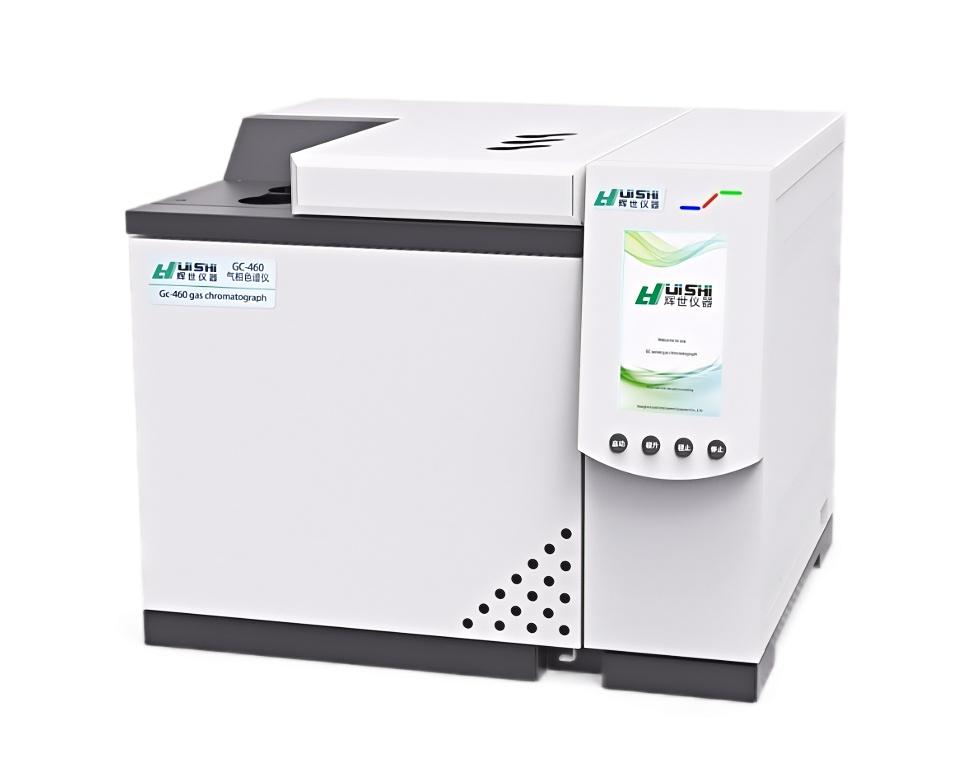
GC-460 gas chromatograph
- Product name
- GC-460 gas chromatograph
- Model
- GC-460
- Brand
- Huishi Instruments
- Manufacturer
- Shanghai Huishi Instrument Equipment Co., Ltd.
- Product category
- Gas chromatograph
- Role of the solution
- It undertakes the tasks of sample injection, separation, detection, and data acquisition in GC analysis.
- Reason for suitability
- The GC-460 can be configured with FID and headspace gas-phase quantitative injection for the separation and detection of acrylonitrile in water samples and samples for volatile organic compounds analysis.
09 Analysis workflow
10 Qualitative, Quantitative, and Quality Control
Identification is based on the retention behavior of the target component and standard substances; calibration is performed using the standard substance corresponding to acrylonitrile, with external standard or internal standard according to the applicable method; injection blanks, calibration verification, and parallel determinations are used to monitor contamination and response stability. Blank headspace vials, parallel vials, calibration verification, and vial-to-vial repeatability are used to monitor the headspace process.
11 Method and Configuration Selection
- The sample must be suitable for achieving reproducible gas-phase partitioning in a sealed vial.
- The equilibration procedure, vial volume, and sampling mode are kept consistent between calibration and samples.
12 Frequently Asked Questions
Why is headspace-GC used for acrylonitrile?
Headspace-GC matches the physicochemical properties of acrylonitrile, the sample inlet, and the detection objective; the complete workflow also covers treatment, separation, detection, and data quality control for water samples and samples for volatile organic compounds analysis.
What samples is this solution applicable to?
The applicable samples are water samples and samples for volatile organic compounds analysis. When the sample source or matrix changes, the effect of coexisting components on pretreatment, separation, and detection response should be re-evaluated.
What components or indicators are included in the detection targets?
The target analyte is acrylonitrile; the main text and configuration are both bounded by the scope of this entity.
How is quality controlled for an analytical batch?
For each batch of samples, set up method blanks, calibration verification, duplicate samples, or applicable QC samples, and retain records of sample processing, instrument conditions, calibration, and calculations.
What information is required before configuration?
It is recommended to provide real samples, a list of target compounds, expected concentration ranges, testing batch size, the method to be followed, and existing equipment conditions.
How are results kept traceable?
Sample numbers, reference materials, processing batches, instrument methods, raw data, calibration results, and review records together form the result traceability chain.
Why is headspace vial sealing important?
The sealing state directly affects the partitioning of volatile components between the sample phase and the gas phase and the injection repeatability.
13 Related Solutions and Knowledge
Get Configuration and Technical Consultation
Please provide sample information for the water samples and samples for volatile organic compounds analysis, the concentration range of acrylonitrile, testing batch size, method basis, and existing equipment. Huishi Instruments will then prepare a configuration list.
Information submitted.